Employee welcome kits: what to include and how to plan the order
An employee welcome kit should give each item a clear purpose. Decide what the new colleague will wear or use, the complete budget, how clothing sizes will be collected and when the kit must arrive. Keep those decisions with the product and artwork references so future hires can be equipped from the same brief.
- Write down a specific use for every proposed item.
- Use the size guide for the actual garment.
- Compare the initial cash outlay with the cost of each kit you can actually hand over.
- Ask whether a proposed date means production finished, dispatch or arrival.
This guide covers welcome merchandise. Work equipment, account access and joining instructions need their own arrangements; branded clothing does not replace them.
Make the decisions before choosing the gifts
Consider the setting. Will people collect the kit at an office, or receive it at home? Are you welcoming one intake or hiring throughout the year? Is the clothing intended for everyday wear, an occasional team event or something else?
Write down a specific use for every proposed item. If its only purpose is to make the box look fuller, reconsider it. There is no compulsory combination of products.
| Decision | What to specify | What to avoid |
|---|---|---|
| Use | Where and when each item will be useful | Adding items solely to fill space |
| Clothing | Exact style, fit, measurements and size choice | Assuming the same size fits across styles |
| Branding | Artwork, dimensions and placement for each item | Applying one file without checking each surface |
| Budget | Products, decoration and included services | Comparing a blank garment with a finished kit |
| Handover | Owner, destination and required arrival date | Treating production completion as recipient delivery |
| Reordering | Product references, quantities and review point | Guessing sizes for people not yet hired |
Choose items for a reason
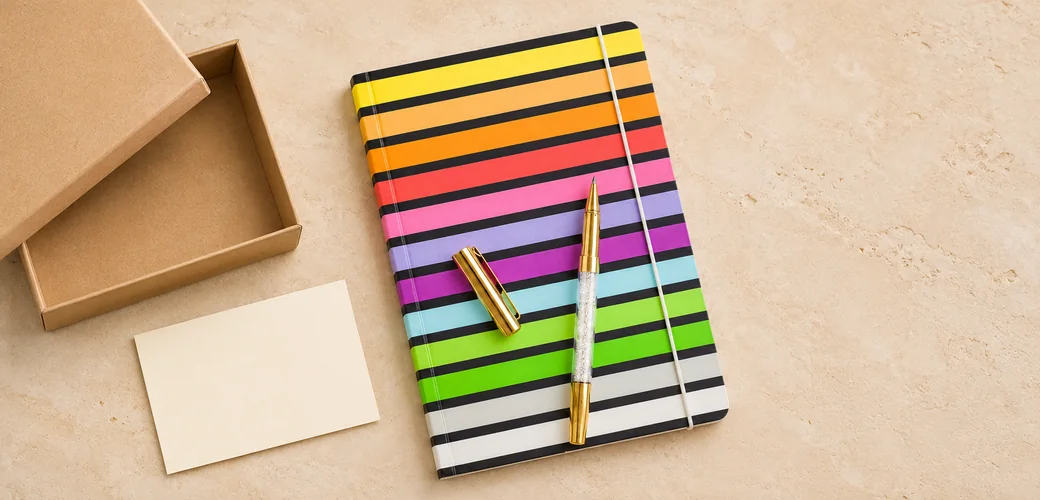
A T-shirt or sweatshirt can anchor the selection if it suits how the team dresses. A notebook may be useful for someone who takes notes; a bag for someone who needs to carry their belongings. Drinkware is an option rather than a requirement: check what the workplace already provides.
Tell us which of these you would like and we will confirm the exact product, branding options and availability. A shorter selection leaves room to focus on fit, finish and presentation.
The personal welcome comes from the employer. A simple card can give the new starter's name and their first point of contact without turning every object into a slogan.
Sort out clothing sizes before decoration
Use the size guide for the actual garment. A relaxed cut and a fitted cut may call for different choices even when they share the same letter sizes. Where practical, check a sample for fit and feel.
If you are planning for future hires, separate the stock decision from the individual size request. Agree how and when each person chooses their size. Personalised garments cannot simply be exchanged afterwards, so ask us about our terms for personalised garments before ordering.
Cost the complete kit
List products and services separately. Alongside the items themselves, check decoration, packaging, cards, assembly, storage and transport. These may be separate charges, and some may need another provider.
Compare the initial cash outlay with the cost of each kit you can actually hand over. Spare units still cost money before they have a recipient. A lower unit price may require a larger first order, so assess it against expected recruitment rather than the discount alone.
Our guide to comparing branded T-shirt quotes explains how to compare garment orders on the same basis.
Plan the first handover and the repeat order
Assign responsibility for confirming each start date, collecting the size and preparing the kit. If some items come from elsewhere, check every item’s delivery date as well as the final assembly date.
Keep the product references, colours, approved artwork and remaining quantities by size. Before reordering, confirm that the style and colour remain available. An earlier order does not guarantee identical replenishment or a fixed turnaround.
Ask whether a proposed date means production finished, dispatch or arrival. The kit needs a confirmed overall schedule, not just a general lead-time estimate.
Send us a brief we can quote
Include the intended users, first quantity, expected future hires, preferred items, known sizes, logo files, budget and required date. Mark essentials separately from optional extras so the selection can be adjusted.
PAMUUC can quote garments and accessories from its merchandise catalogue. If you need a complete pack, specify packaging, assembly and distribution separately and confirm which services can be included. Do not assume they are part of the garment quote.
Read how ordering works and prepare your merchandise request. Aim for a useful selection with a clear scope and a repeat-order process the team can manage.
Related reading
Embroidery: what makes a logo legible?
Check the lettering, gaps and outlines of a logo at its intended size before approving embroidery for company clothing.
How to check an artwork proof
Compare the garment, artwork version, logo size and placement on a proof before approving a branded T-shirt. Use a brief your team can check together.
Approval samples for clothing orders
An approval sample is included from 100 pieces per product. Learn when it is made, what to review and why written approval is required before production.