Prepare a size list for branded clothing
Build a clothing size list around the exact product, colour and variant. Keep unresolved sizes visible and reconcile quantities before requesting your quote.

- Collect sizes for the product option you intend to order.
- Keep confirmed quantities separate from unresolved choices.
- Reconcile each product total before you send the brief.
A clothing size list should identify the product, selected option and colour before it counts sizes. Record how many pieces you need in each size, keep unanswered choices visible and reconcile the total for each product. Send the list with your artwork and requested date so the quote can reflect the order you intend.
Start the size list with a product
Choose the product before you circulate a sheet. A list headed only “team T-shirts” leaves the person preparing the quote to guess which option you mean. Use the T-shirt collection to identify the product you are considering, then record its name or reference and the selected option beside the colour.
Keep a separate block for each product and colour. If you plan to order both a T-shirt and a hoodie, ask people to choose for each item. Treat a repeated size label as a response for that item, rather than silently copying it to the other garment.
Ask for a choice you can use
Share the exact product option with the people choosing. Ask them to return the size label shown for that option. If someone is unsure, keep that response separate from the confirmed quantities. Do not turn a blank cell into an assumed size simply to complete the sheet.
When another colleague collects the responses, give them the same product reference and colour. Keep one working list with a clear owner. A reply in a separate message should be added to that list before you total the order. You can then explain whether an unanswered row is still open or has been removed from the request.
Check the selected option
PAMUUC’s catalogue groups several options within a product family. The available size labels belong to the selected option. A size that appears elsewhere in the family does not establish that it is offered for the option you chose. Check the selection you intend to order before you finalise the breakdown.
The list is an ordering brief. It cannot establish fit for a person who has not made a choice. If a size question remains unresolved, describe it in the request instead of presenting it as confirmed. Ask about the exact product, so the answer can relate to the same item your team has seen.
Reconcile quantities before sending
Add the confirmed quantities for each product and colour, then compare that total with the quantity in your request. Check whether any response has been entered twice, left outside the total or assigned to a different option. If the artwork differs between groups, describe that difference beside the affected group.
The ordering guide explains how the request leads to a quote and approval. Include the requested delivery date with the list. A spreadsheet deadline for collecting sizes is your planning choice. The delivery date for the order is confirmed in the quote.
A final handover check
As of 11 November 2026.
- Catalogue selection. Exact product option and colour.
- Size breakdown. Size label and quantity for that option.
- Order review. Quote and artwork approval before production.
Check the artwork separately from the size count. The decoration overview helps you name the method in the brief. PAMUUC provides a placement proof at real size before production. Review the proof and price alongside the final list, so the approval refers to the order your team has actually checked.
Related reading
Embroidery: what makes a logo legible?
Check the lettering, gaps and outlines of a logo at its intended size before approving embroidery for company clothing.
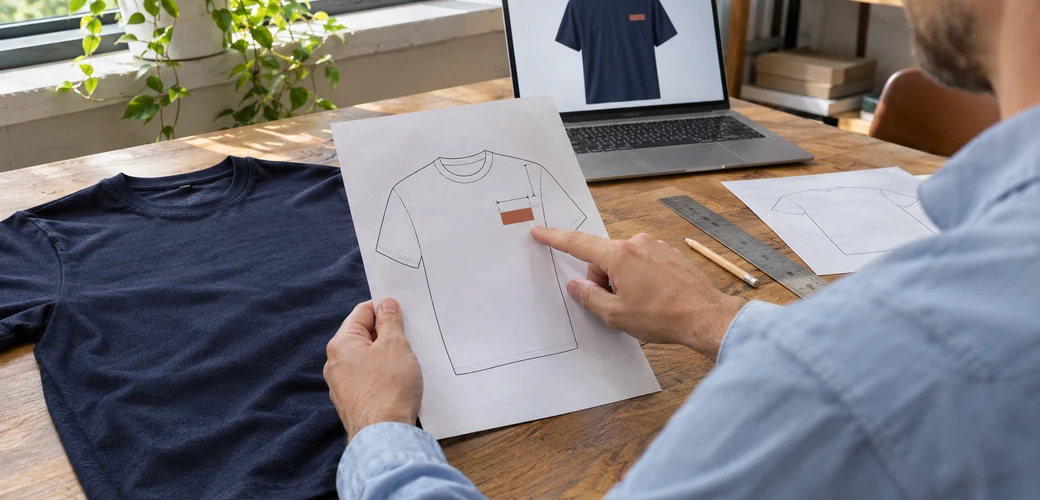
How to check an artwork proof
Compare the garment, artwork version, logo size and placement on a proof before approving a branded T-shirt. Use a brief your team can check together.
Approval samples for clothing orders
An approval sample is included from 100 pieces per product. Learn when it is made, what to review and why written approval is required before production.